This is how I die, I thought as the frigid water numbed my body.
I was struggling to keep my head above the turbulent Lochsa River, in the heart of Idaho’s rugged wilderness. Until that moment, the rafting trip had been such great fun. But then, in just a few seconds, everything had changed. Our paddle raft, with a group of eight friends and a guide aboard, had hurtled toward a boulder, and before we could do anything, it had crashed and tossed everyone into the water.
My floatation vest seemed to be pushing me up, but I wasn’t breaking the surface. That’s when I realized that the raft was upturned and I was pinned inside it. I wasn’t a swimmer, and although I tried desperately to free myself, none of my efforts worked. The unrelenting power of the river dragged me along violently, hurling me into rocks as the current pulled me under. And it was in that moment that I thought, This is how I die.

With no other choice, I made peace with the inevitable, and all at once, my panic gave way to calm. Who should I live for? I asked myself.
Prompt came the answer in my head: My mother and sister are taken care of now.
Let me give you some background. I grew up in Hyderabad, India, the younger of two children in a middle-class family of four. Excelling in studies and sports, life felt steady and promising. But, that sense of stability did not last. On my sixteenth birthday, my father walked out of our lives. Almost overnight, we kids became exposed to the crude reality of the world. In the years that followed, I found solace in the search for Truth. I became deeply drawn to Vedantic philosophy and, at one point, even contemplated becoming a monk. But I soon realized that such a path, however meaningful, would not address my family’s immediate and very real needs.
Almost instinctively, by the age of eighteen, I assumed responsibility for my family’s security. The objective was straightforward: ensure our survival. To give that resolve shape and direction, I set myself a concrete goal: within fifteen years, I would earn Rs. 2 crore (about $500,000 at the time). From then on, my attention narrowed and priorities became clear. Education, professional success, and financial stability became not aspirations, but necessities.
Over the next decade, I pursued these goals relentlessly. When you know where you’re going, the whole world seems to pave the way for you. At least, that’s how it was for me. As if by magic, people came into my life at the right time and the right place. They nudged, encouraged, and helped me succeed, carrying me first from poverty in Hyderabad to the Indian Institute of Technology in Bombay, and later, to a PhD in the United States and a successful career in the semiconductor industry. I often wondered if coincidences like these happen truly by chance, or whether there was something else going on.
Which brings us back to the Lochsa River.
Pinned up against the inside of the inverted raft, I started swallowing water. A surprising calm state of mind dawned upon me, and I distinctly felt comforted by the fact that my family was well taken care of. And, at this point, I also seemed to be resigning myself to death. Why do I need to keep living? I asked myself.
The answer came back in what I can only describe as a strong knowing inside me.
“You have not yet fulfilled your purpose in life.”
Instantly, a flash of insight directed me to “walk.” And walk, I did. Using my hands to feel the inside of the upturned raft, I “walked” until I found the edge of the raft and bobbed up, freeing myself from my underwater trap, and taking in a great big breath of Life.
Reflecting on the experience later, I realized just how easily life can slip through our fingers while we’re consumed by daily struggles—juggling responsibilities, chasing ambitions, or simply trying to stay afloat. And, I kept returning to that insight: You have not yet fulfilled your purpose in life. Where had it come from? Of course, I knew it had come not only from somewhere within me, but also from a deeper core that I had never known.
Weeks, and then months, of contemplation kept presenting me with the same burning questions. If life can end at any moment, and if all we have—including time—is limited, then what truly matters? If, indeed, my purpose on Earth is what I must truly care about, then instead of constantly getting lost in the pursuit of ultimately meaningless goals and achievements, how can I instead live out that purpose? And, do I discover my purpose, or do I determine it myself? Either way, how? Then again, surely life can’t be all about purpose. It’s also about joy in everyday moments, the pursuit of happiness, a sense of fulfillment derived from making a creative contribution to the world, and so much more. So, how do I fit all that together into a cohesive whole?
In the later stages of my journey, I could see that the answers lay somewhere at the intersection of the materialism I was chasing and the inner seeking I’d rediscovered in the Lochsa River. However, being scientifically minded, robust answers eluded me because the former (materialism) was the domain of comfort, logic, and pursuit, while the latter (search for inner truth) was the domain of purpose, creativity and freedom.
In both my academic and professional life conducting research in cutting-edge semiconductor technology, I’ve learned that the key to solving any problem lies in understanding the root causes. The process begins with a clear problem statement, gathering the complete background information, forming multiple hypotheses, testing them in the lab, and then examining the results. You eliminate the unlikely explanations until you find the one that best explains the evidence. If none of the hypotheses work, then you start all over again and go deeper.
Life, with all its complexities, is not so different. When faced with a personal challenge, I always explored it from multiple perspectives and found that our past experiences shape our understandings—our hypotheses. Consequently, each person will arrive at their own, unique solutions for their hypotheses. That’s the nature of life. Problems are universal, but solutions are deeply personal, colored by various hues of logic and emotions. So, how, then, do we make sense of life’s challenges?
The answer clearly lies in understanding the fundamental forces within us that give rise to these problems in the first place. As I embarked on this pursuit, every opinion that I ever read, witnessed or heard became a hypothesis, and every decision became an experiment in the lab of Life. That meant I had to bear the full weight of my decisions, which trained me to welcome any setbacks as opportunities to learn and grow, and in turn, informed my future experiments.
Soon, I started noticing patterns. When survival was on the line, I instinctively prioritized protecting and defending myself and my family. As I learned to overcome self-sabotaging thoughts, I became more skilled at setting clear goals and achieving them through grit and persistence. In other words, I negotiated with the world: I offered my services and, in return, received what I absolutely needed. As my basic needs were secured, I found deep fulfillment in giving—offering my skills and resources to help others grow and reach their potential. And, finally, guiding me through it all was a quiet, impartial knowing within, a presence that I came to recognize as my inner yogi. What if I told you that these patterns are common to each one of us?
Why Now?
The questions that surfaced during that moment of surrender in the river are not mine alone. Today, they echo in the minds of many who lead lives filled with responsibilities, ambitions, and achievements, but who also feel a deep void within. We strive for happiness through material success, relationships, or personal growth, only to find that fulfillment remains elusive. Despite our best efforts—embracing mindfulness, reading self-help books, or seeking spiritual experiences—lasting joy often slips through our fingers.
The problem isn’t lack of effort, it’s our “inside the box” understanding of life. We compartmentalize philosophy, psychology, and neuroscience, failing to see how they interconnect. We chase goals in the outside world while neglecting the inner work required to experience joy in the here and now. The answer, of course, isn’t to give up goals, or to renounce responsibilities and just sit idly under a tree. The answer is to welcome all aspects of ourselves—to become integrated as a fully functional human. It’s not about one or the other—material or spiritual, inner or outer, earth or heaven, masculine or feminine, self or other—but about union and balance. Four-way balance, in fact.
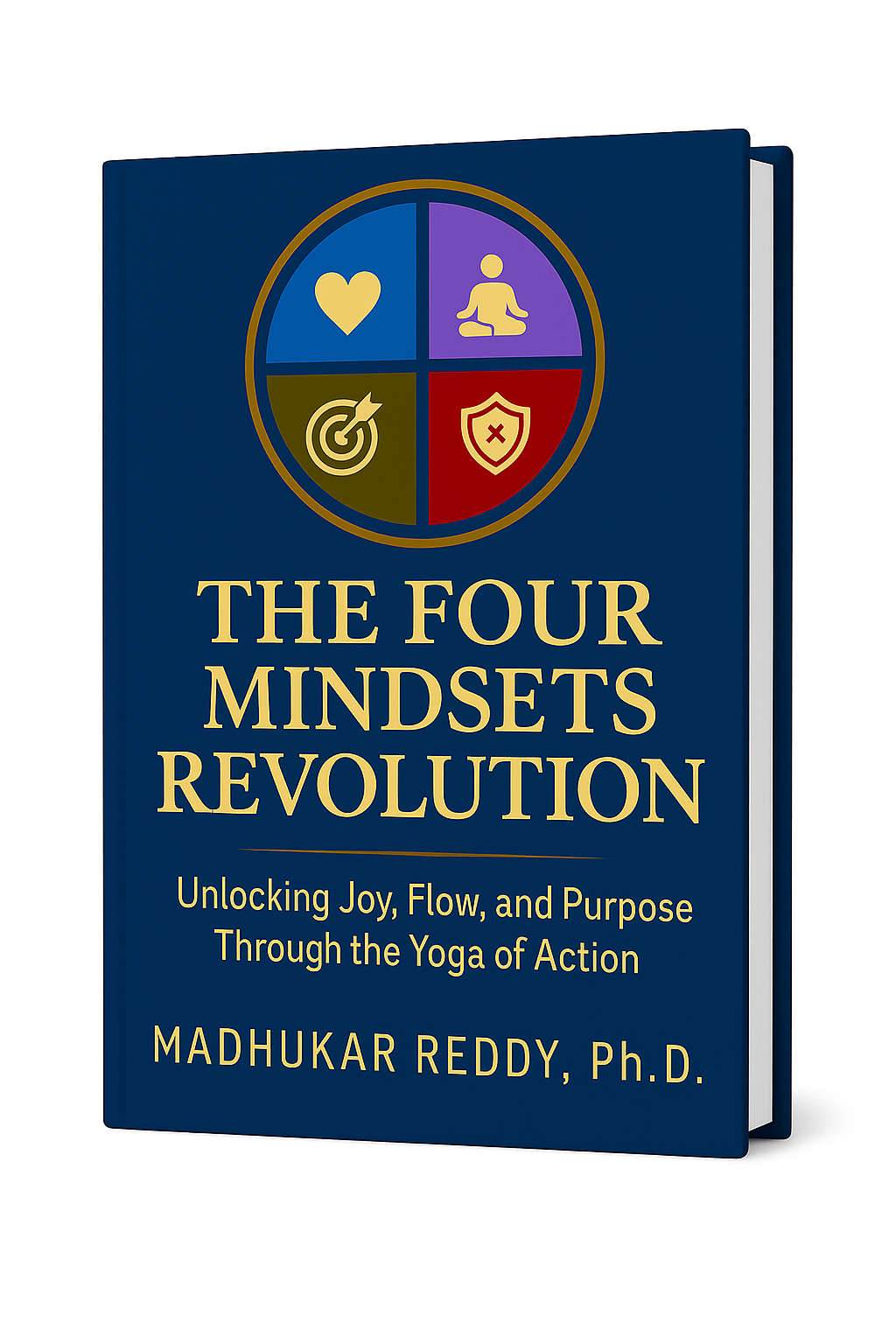
In this book you will find a digestible collection of ground-breaking research in the fields of neurobiology and psychology, which shows the inner workings of four fundamental mindsets that influence our thoughts, words, actions, and reactions. These Four Mindsets are the root causes, the deep drivers, behind the way we live our lives. Between them, they explain all of human behavior, rationality, emotions, and faith. By understanding these Mindsets, we not only gain insight into the problems we face, but also the most authentic and effective paths to our solutions, some of which may be thought of as being “out of the box.”
Your Journey in This Book
Fortunately, you don’t need a near-death experience to start this journey to joyful living, creative fulfillment, and lasting purpose. It begins in quiet, everyday questions such as, “Am I living true to my dharma?” and “Am I balancing my responsibilities with my dreams?” Whether your challenges are dramatic or subtle, this book is your guide to unlocking the joy, flow, and purpose that is within you. It offers a practical framework rooted in ancient philosophy (taking advantage of the profound insights bequeathed by our wise ancestors), modern psychology, and neuroscience. By the end of this journey, you will:
- Understand the four fundamental mindsets that shape your actions and decisions: the Defender, the Negotiator, the Giver, and the Yogi. The Defender shields us from harm, ensuring safety and stability in an unpredictable world. The Negotiator strategizes, balancing risks and rewards to achieve meaningful goals. The Giver fosters compassion and selflessness, finding purpose in uplifting others. The Yogi rises above all the others, embracing joy and peace through detachment.
- Discover how to fully engage and harmonize these mindsets to achieve balance, joy, bliss and peace in your life.
- Learn how to transform your daily actions into a source of joy (which we will call Karma Yoga).
The book is divided into three parts:
- Discovering the Four Mindset Framework: Uncovering the deeper purpose of life and understanding the mindsets that drive us.
- Exploring the Four Mindsets: Diving deep into the neuroscience, ancient philosophy, and psychology of these mindsets, and their integration in Karma Yoga.
- Integrating and Transforming: Integrating these insights to awaken the Karma Yogi within you, unlocking your limitless potential for creativity, purpose, and joyful living.
Part I lays the foundation by helping you confront life’s fundamental questions, such as: Why am I here? What is the purpose of my life? We begin by exploring the four core mindsets—Defender, Negotiator, Giver, and Yogi, which shape your thoughts, emotions, and actions. You’ll learn how these Mindsets relate to ancient philosophical frameworks like the Purusharthas (purposes of life), modern neuroscience, and personal psychological patterns. As you examine your inner world, you’ll also uncover the three internal locks—intellectual, emotional, and spiritual—that limit your growth. This part equips you with the essential conceptual and practical tools to begin your personal transformation through the lens of Karma Yoga, setting the stage for deeper exploration ahead.
In Part II, we journey into the heart of each Mindset. Through sufficiently deep-diving into psychology, neuroscience, and relatable life examples, you’ll understand the Defender, Negotiator, Giver, and Yogi not as fixed personality types, but as inner programs we can strengthen, adapt, and harmonize. Each Mindset gets its own chapter, where you’ll learn to recognize its gifts and its limitations in your life.
A special note concerning neuroscience in this book. Neuroscience studies suffer from small sample sizes and cross-sectional designs that cannot prove causation, etc. As such, care has been taken not to draw conclusions with a broad stroke, or confuse correlation with causation. Drawing on emerging research, the aim is to educate the reader about the fascinating overlap between seemingly disparate realms that, in fact, come together in the human body. Keep an eye out for evolving neuroscience research on these topics. This edition captures the state of knowledge up to early 2026, but new discoveries will continue to shed light on the various topics touched upon in this version.
Finally, Part III is your practical guide to integration and mastery. Creativity, joy, purpose, and flowbecome central themes as you discover how to bring harmony into your daily actions and unlock your fullest potential. The journey culminates in the awakening of the Karma Yogi within you: someone who acts with clarity, compassion and resolve, and lives with joy, tackling everything that life throws at them.
This book isn’t meant to be passively read: it’s intended to be experienced. Along the way, you’ll find reflective exercises and journaling prompts designed to help you engage with the material more deeply. I invite you to pause, question, and reflect as you move through each chapter. These reflections are where theory turns into insight! In fact, the more actively you participate, the more transformative your experience will be. At the end of Chapter 2, you’ll find an online Mindset Composition Test (you can take it here) that will provide you with a personalized report, which will detail your strengths, weaknesses, opportunities and challenges. The book, then, acts as a map to guide and help you return to the joy, clarity, and purpose that you are capable of experiencing every single day.
While this book offers you a personal journey inward, it is also part of a much larger collective path. You are not alone in asking deep questions about life. As you explore the ideas in this book, I encourage you to connect with others who are on a similar journey, whether in your local community, through group discussions, or in online spaces dedicated to mindful living. Sharing your reflections and learning from others can deepen your own understanding and amplify your growth. This is, after all, not just about awakening the Karma Yogi within you, but about nurturing a world where more of us live, act, and lead from that place.
So, let us begin not with the assumption that joy and purpose lie somewhere out there, to be earned through achievement or found in the distant future. Instead, let’s explore how they can be cultivated right here, right now through conscious action and awakened living. With open minds and willing hearts, let’s take the first step on this journey by reflecting on one of the most fundamental of human questions: What does it really mean to live with access to joy, flow, and purpose?
OM Shanti Shanti Shantihi
—Madhukar Reddy