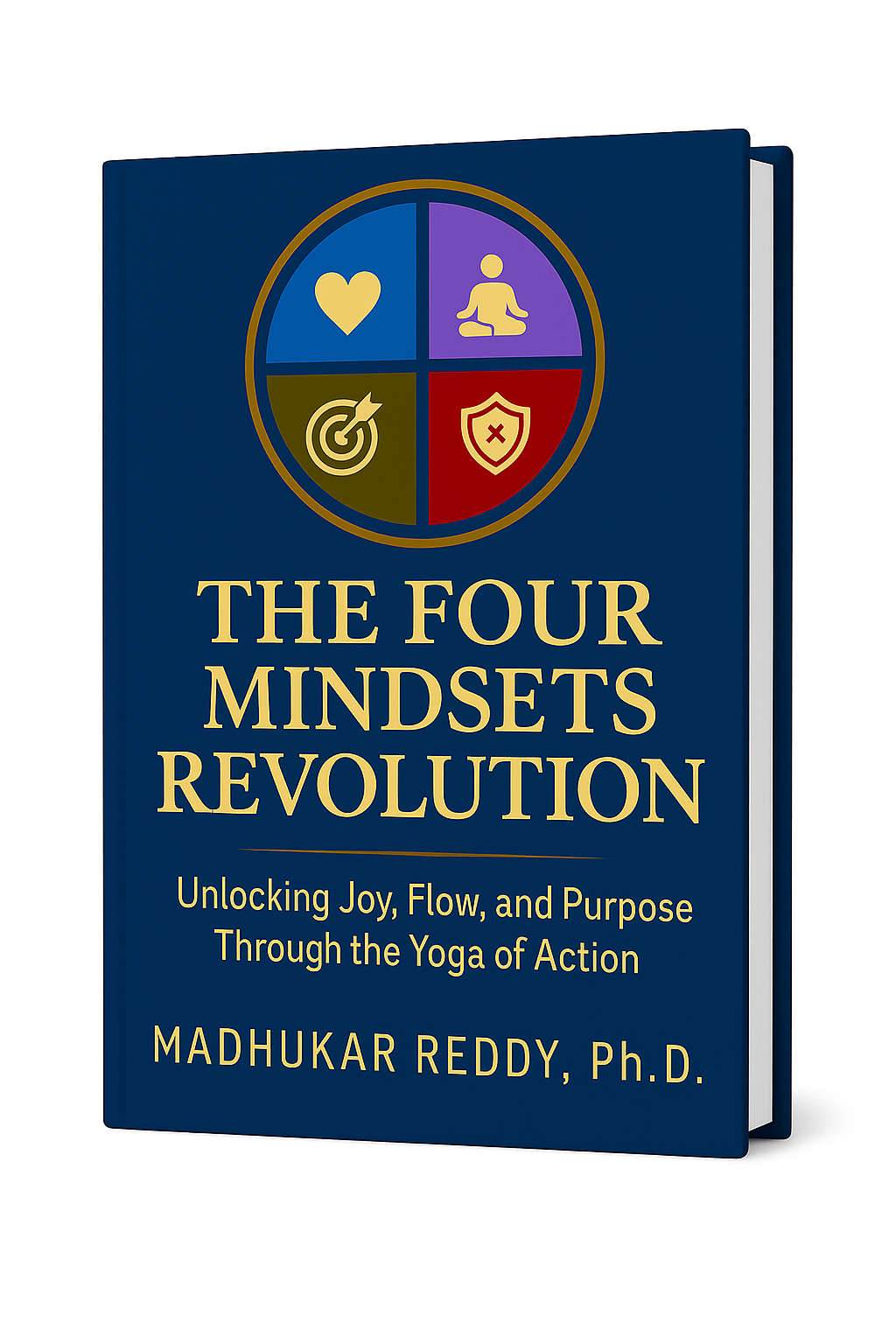
Mindsets are the brain’s working models for a given moment—what to predict and how to respond—learned through experience and trainable with practice. Mindsets matter because they link meaning to action. How we meet each moment sets attention, feeling, and bodily state, changing what we do now and, repeated over time, our habits, health, and well-being.
This isn’t just theory. Above the Arctic Circle, in Tromsø, Norway, people who hold a “winter-as-opportunity” mindset, compared to a “winter-as-burden” mindset, report better mood and coping through the months of polar darkness. In hotel staff, simply reframing daily work as exercise produced measurable improvements in health markers, including reductions in weight and blood pressure, even without reported behavior change. And in karaoke, public speaking, or timed math, a simple mindset flip to “I’m excited” led to better performance, beating “I’m anxious” in karaoke, and “I’m calm” in the other tasks. Even in everyday life, calling the same milkshake “indulgent” instead of “sensible” led to a larger drop in the hunger hormone ghrelin—the body’s “I’m full” signal—and greater satiety, another example of expectations changing physiology.
Why this matters now: when daily life pulls our attention and keeps arousal high, mindsets offer a practical way to train attention, lower arousal, and align our actions with our values. Despite the name, mindsets aren’t “set”—they’re adaptable and change with practice. This book doesn’t assign you a mindset to explain and direct your actions; instead, it provides a guide for shifting between mindsets to respond more skillfully to whatever arises and seek greater alignment between your values and your actions.
I’m a neuroscientist and mindfulness researcher—curious about how mindsets tune prediction, attention, and choice in the brain. I’ve also learned that how I show up changes what happens in the moment and how I replay it later—from exhausted to connected as a parent, from imposter to learner in academia, from stuck to experimental in research, from overwhelmed to resourceful in daily life. Reading The Four Mindsets Revolution didn’t just build on my understanding from mindset studies, it reminded me of the impact my mindsets can have in the messy reality of daily life, and that small, intentional shifts can drive meaningful change over time—and they’re worth the effort.
This book offers four core mindsets, integrated across yogic philosophy, neuroscience, and psychology, and shows how to practice them in everyday life. It engages popular models of personality, creativity, and behavior change without overclaiming, and uses left-brain/right-brain narratives while acknowledging that most functions are distributed across bilateral brain networks. Karma Yoga (Yoga of Action) is presented as the practical framework for integrating mindsets—act skillfully, observe results, adjust, and let go of outcomes. Rather than typing people, it shows how mindsets can be applied and integrated to fit the moment. Common barriers to working with each mindset are identified, and a brief self-assessment provides your baseline mindsets and barriers so learning can be personalized.
The book stands out in three ways:
- First, it’s clear about what the tradition and the science can and can’t say, inviting the reader to test claims in practice.
- Second, it integrates yogic philosophy with current models of attention, valuation (self-relevance & value), control (focus & self-regulation), and our default mode (self-processing & mind wandering), illustrating how to shift and balance mindsets to support joy, flow, and purpose. For example, you’ll see how a simple practice like self-affirmation, suggested here as mantras, can boost the brain’s “this matters to me” signals and support behavior change. You’ll also learn how Yoga Nidra, or non-sleep deep rest, can calm the brain to support intention setting and mindset shifts.
- Third, the book is built for busy readers—concise explanations, measurable exercises, and an emphasis on observable results. It’s for those who seek deep work and live demanding lives.
This book won’t do the work for you—what it offers is better: a clear map, careful science, and tools that leverage both neuroplasticity (the brain’s capacity to change with practice) and human adaptability.
For readers who like organized thinking and modest, testable steps:
– if you’re grounded in yoga and want actionable evidence, you’ll find it here;
– if you’re familiar with the science and want roots in a coherent tradition, you’ll find that too.
Built for use in context, the book meets you in the moments that matter. Pick one mindset, apply it where you are, watch what shifts, and let that guide the next step.
Kathleen A. Garrison, PhD (Neuroscience)
Associate Professor, Department of Psychiatry
Yale School of Medicine, New Haven, CT
August 2025