I have been a student of the Bhagavad Gita for decades and have engaged with its insights as a psychiatrist, neuroscientist, teacher, and student of the human condition. This has convinced me that the Gita is a profound manual for living and acting well in the midst of complexity. At the heart of the Gita vision is the discipline of doing the right thing (Dharma), and doing it well, with clarity, skill, and freedom from attachment to outcomes (Karma). Far from advocating passivity or fatalism, Karma Yoga teaches engaged action without being imprisoned by anxiety, ego, or fear. The Gita’s genius lies in reframing action itself as the arena of growth where inner freedom and outer responsibility are not opposites, but partners.
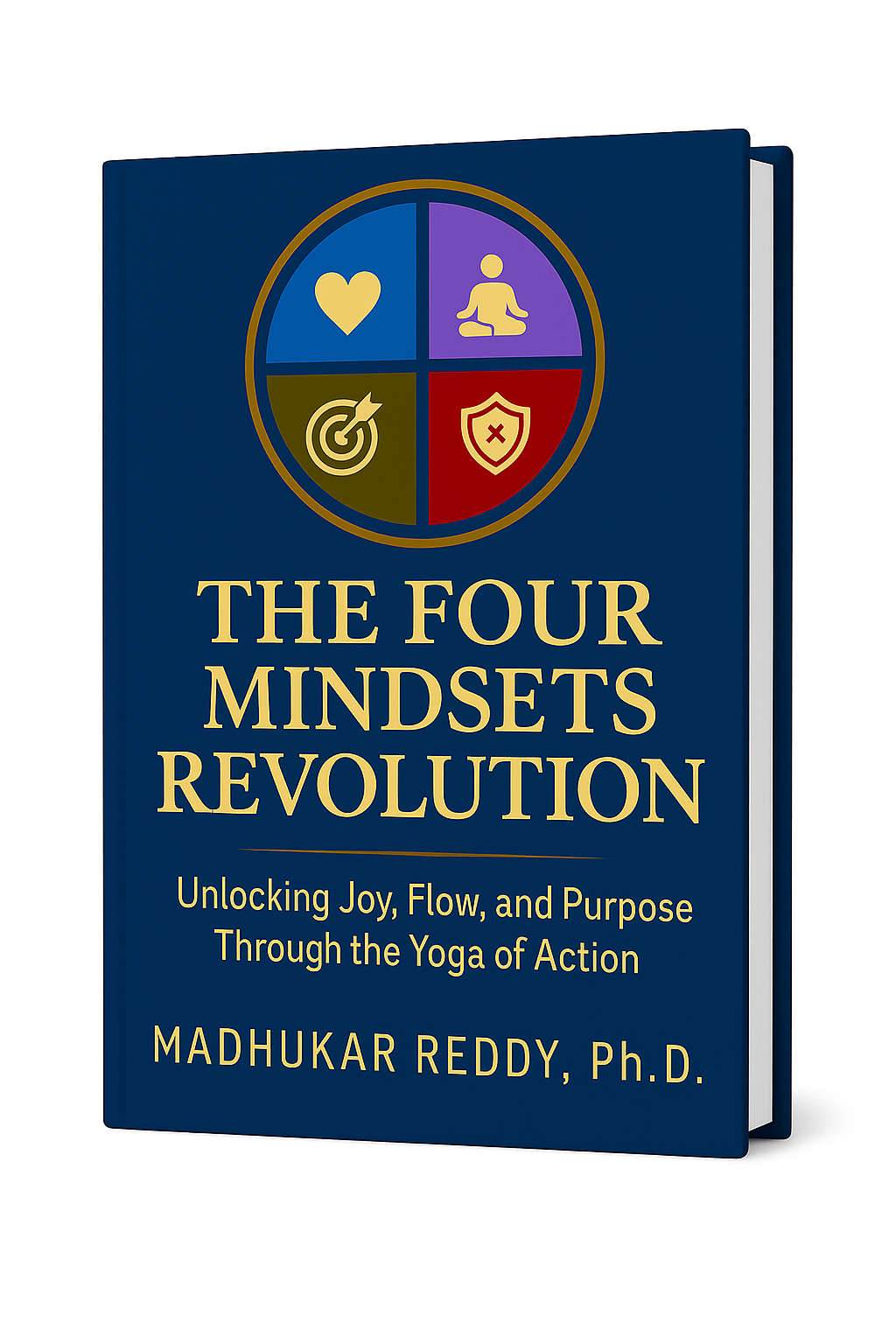
The Four Mindsets Revolution by Madhukar Reddy is a compelling and original contemporary articulation of this ancient wisdom. This book speaks to a modern reader caught between competing demands of achievement and meaning, ambition and balance, individuality and responsibility, much like Arjuna on the battlefield of Kurukshetra. It is a metaphor for today’s battlefield, which is not one of bows and arrows, but of careers, relationships, technology, uncertainty, and relentless performance pressures. Yet the psychological dilemma remains strikingly similar: How do we act fully in the world without losing ourselves to fear, desire, or exhaustion?
This Four Mindsets framework offers a practical answer. Defender, Negotiator, Giver, and Yogi each correspond to deeply conserved human capacities independently recognized by modern neuroscience, psychology, and ancient Indian thought. What makes this framework particularly powerful is not merely its descriptive clarity, but its integration through Karma Yoga as a living practice. In the Gita, Krishna does not ask Arjuna to abandon action, nor to suppress his emotions, nor to retreat into transcendence. Instead, he invites Arjuna to act from a transformed inner posture:
Yogasthaḥ kuru karmāṇi
“Steadfast in yoga, perform action”
This “steadfastness” is precisely what this book seeks to cultivate. The Defender safeguards survival and security; the Negotiator enables planning, mastery, and achievement; the Giver anchors ethics, compassion, and service; and the Yogi provides the spacious awareness that prevents identity from collapsing into outcomes. None of these, by themselves, is sufficient. Karma Yoga emerges when these mindsets are harmonized, rather than allowed to dominate one another. In fact, the term Yoga literally means balance, or harmony.
This perspective resonates deeply with what we now understand about the brain, health and human functioning. Mental health is not the absence of striving, but the flexibility to shift states between effort and rest, engagement and letting go, self-interest and altruism, without rigidity or fragmentation. The Gita anticipated this insight millennia ago, and this book resonates with the modern reader without diluting its depth.
Too often, contemporary discourse swings between spirituality and practical wisdom. The Four Mindsets Revolution does not romanticize either, and avoids this false dichotomy. Like the Gita itself, it insists that excellence without attachment, service without self-erasure, and inner freedom without disengagement are not only possible, but necessary in our times.
Equally important is the book’s insistence on practice. By grounding ancient wisdom in neuroscience, behavioral science, and reflective exercises, Madhukar Reddy reminds us that transformation is incremental, embodied, and deeply personal. Liberation, in this sense, is not a distant metaphysical event, but a series of small inner realignments enacted in daily life.
This book will feel both reassuring and challenging for readers seeking a spirituality that does not ask them to withdraw from responsibility, a psychology that honors depth without losing rigor, and a philosophy that dignifies action rather than escaping it. It stands firmly in the lineage of the Gita’s central message: Freedom does not come from renouncing action, but by changing how you relate to the outcomes.
If Krishna were to counsel Arjuna today, his teaching is likely to look less like a sermon, and more like the message in this book: practical, integrative, and gently reminding us that peace and contentment are not somewhere else. They come to us when we learn to do the best thing, do it well, and then just let go of clinging to the outcomes.
Matcheri S. Keshavan, MD
Stanley R. Cobb Professor of Psychiatry
Harvard Medical School