Abhyasa: Repeated deliberate practice to achieve mastery.
Ahankara: The”I-am-ness” representing the sense of self or the identification with the individual ego. A container for our various identities, appearing as one coherent ego-identity.
Ahimsa: The principle of non-violence and respect for all living things, a fundamental tenet in various Bharatiya religions.
Ajna: The third eye chakra, associated with intuition and imagination.
Anahata: The heart chakra, associated with love, compassion, and emotional balance.
Ananda: Bliss or divine joy, a state of supreme happiness.
Aparigraha: Non-covetousness, one of the Yamas in Patanjali’s Ashtanga Yoga.
Artha: Material stability. One of the four Purusharthas; it refers to the pursuit of wealth, career, financial security, and prosperity.
Asana: A physical posture or pose in yoga, each with specific benefits for the body and mind.
Ashtanga Yoga: The eight-limbed path of yoga described by Patanjali, encompassing ethical guidelines, physical postures, mindful breathing, and higher states of consciousness.
Asteya: Non-stealing, one of the Yamas in Patanjali’s Ashtanga Yoga.
Atma/Atman: Equivalent to True Self in this book, it represents the pure, unchanging consciousness within an individual. In Sankhya philosophy, this principle of consciousness is known as Purusha, while in Vedanta, it corresponds closely to Brahman, the ultimate, non-dual reality. However, it’s important to note that while Sankhya distinguishes between multiple Purushas and separate material nature (Prakriti), Vedanta views Brahman as a singular, unified reality underlying all existence.
Bhagavad Gita: A sacred Hindu scripture consisting of a conversation between Prince Arjuna and Lord Krishna, addressing the nature of life, duty, and spirituality.
Bhakti Yoga: The path of devotion and love for the divine, one of the main types of yoga.
Brahmacharya: A concept that translates to “conduct that leads to Brahman (the supreme reality)”; often interpreted as control of the senses.
Brahman: The infinite, transcendental reality, often described as pure, limitless consciousness. It is the ultimate source underlying all existence, beyond all forms, attributes, and distinctions. Unlike the ego-driven False Self of the KarmicNet, Brahman represents the realm of Infinite Potential and our True Self, accessible through self-realization.
Buddhi: The materialistic intellect or rational mind that makes decisions in the KarmicNet.
Chakras: Seven energy centers in the body, each associated with specific physical, emotional, and spiritual goals and functions.
Chit: Consciousness or pure awareness.
Chitta: The mind-stuff that holds thoughts, emotions, and memories, influencing behavior and perception.
Chitta Shuddhi: Purification of the chitta, removing negative samskaras—distractions and emotional disturbances—that get added over the course of daily life.
Choiceless Awareness: A state of mind where one observes thoughts and experiences without preference or attachment.
Dharana: Concentration, the sixth limb of Patanjali’s Ashtanga Yoga, involving deep focus on a single point or object.
Dharma: Principle of live and let live. One of the four Purusharthas; it means “the path of righteousness” and represents behaviors that are in accord with rita. It signifies our purpose and a commitment to righteous living, prioritizing our innate duty to protect and care for the vulnerable, extending to all men, women, children, and nature, including plants and animals.
Dhyana: Meditation, the seventh limb of Patanjali’s Ashtanga Yoga, where the mind is in uninterrupted flow toward the object of focus.
Ego: The sense of individual identity that can lead to self-centered behaviors and thoughts.
Ego-Transcendence: Moving beyond the ego’s selfish concerns to experience a higher state of consciousness or self-awareness.
Giver Mindset: A mindset characterized by altruism, empathy, and the desire to help others.
Gnyana: Knowledge or wisdom.
Gnyana Yoga: The path of knowledge and wisdom, one of the main types of yoga.
Gunas: The three fundamental qualities (Sattva, Rajas, Tamas) that influence human behavior.
Hatha Yoga: A branch of yoga focusing on physical postures (asanas) and mindful breathing (pranayama) to prepare the body for meditation practices.
Ishwara: A personal god or concept of God (anything that is elevating) in yoga and Vedanta philosophy.
Ishwara pranidhana: Dedicate, devote or surrender to a higher power, whether that is God or anything elevating.
Jeevanadhi: A metaphorical flow of life that aligns with the cosmic order rita, guiding an individual through their journey. It represents the deeper purpose of existence that aligns with the broader principles of dharma and the purusharthas.
Kama: Emotional fulfillment. One of the four Purusharthas; it represents desires, passion, and aesthetic enjoyment.
Karma: Literal meaning is action. Law of Karma is the law of cause and effect where one’s actions influence future experiences.
Karma Yoga: The path of non-selfish action performed as a duty, service, or simply without attachment to results.
Karma Yogi: An individual who practices Karma Yoga.
Kriya Yoga: Internal practice involving tapas, svadhyaya, and ishwara pranidhana toward becoming a better version of ourselves.
Manipura: The solar plexus chakra, associated with personal power, self-esteem, and transformation.
Mantra: “A conduit to mind”; in this book, self-affirmation. Traditionally, it is a sacred utterance, sound, or phrase used in meditation and spiritual practices to focus the mind and connect with higher consciousness.
Maya: In this book, Maya refers to the distorted perception of reality created by the False Self, driven by ego, fear, desires, and past conditioning within the KarmicNet. Traditionally, Maya is the illusion that obscures the True Self, keeping us trapped in cycles of attachment, misinterpretation, and limited understanding of reality.
Mantra-affirmation: The practice of repeating a mantra, for meditation and spiritual growth.
Meditation: A practice to quiet the mind and connect with the True Self.
Mindsets:
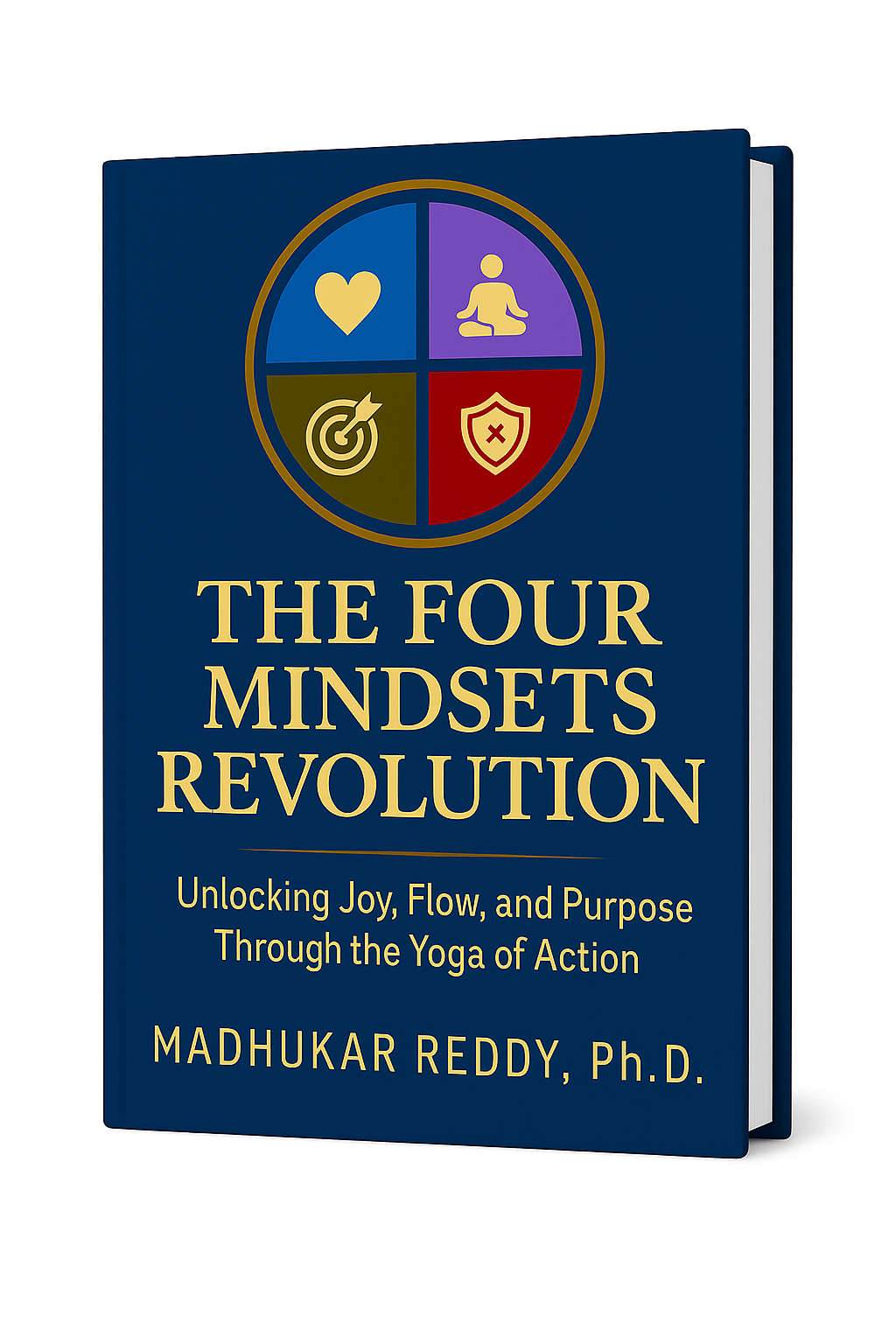
—Defender Mindset: Focused on self-preservation and protecting one’s interests.
—Negotiator Mindset: Driven by logical analysis, goal setting, and achieving personal objectives.
—Giver Mindset: Characterized by altruism, empathy, and the desire to help others.
—Yogi Mindset: Aimed at spiritual growth, inner peace, and understanding the deeper aspects of life.
Moksha: Practical state of inner peace. Traditionally, liberation from the cycle of birth and death. But, in this book, we invoke moksha to mean self-realization and unity with the divinity within us.
Muladhara: The root chakra, associated with physical identity, stability, grounding
Namaste: A traditional Indian greeting meaning “I bow to (the divinity within) you.”
Neuroplasticity: The brain’s ability to reorganize itself by forming new neural connections throughout life.
Nishkama Karma: Performing actions without any expectation of rewards, focusing solely on the process.
Niyama: The second limb of Patanjali’s Ashtanga Yoga, consisting of personal observances like Saucha (mental and physical cleanliness), Santosha (contentment), and others.
Om: The primordial sound or vibration considered the essence of the universe and used as a mantra in meditation.
Prakriti: The material world or nature, in contrast to Purusha (pure consciousness) in Sankhya philosophy.
Pranayama: The practice of mindful breathing in yoga.
Prasada Buddhi: A rewarded mindset that views the present as a series of blessings, fostering acceptance of what is.
Pratyahara: Withdrawal of the senses, the fifth limb of Patanjali’s Ashtanga Yoga, turning the mind inward and being in the present-moment.
Purusha: Pure Consciousness, as opposed to Prakriti (the material world) in Sankhya philosophy.
Purusharthas: The four aims of human life in Hindu philosophy—Dharma (purposeful duty, ‘live and let live’), Artha (material prosperity), Kama (pleasure and emotional fulfillment), and Moksha (a practical state of inner peace, self-realization).
Rajas: One of the three gunas, representing activity, passion, and restlessness.
Rita: The cosmic order that makes life and the universe possible. If there is no such order, there is no possibility of life as we know it.
Sahasrara: The crown chakra, associated with pure consciousness and spiritual enlightenment.
Sadhana: Spiritual practice or discipline aimed at achieving self-realization.
Samadhi: Highest point of meditation, where we feel completely united with everything around us.
Samsara: The cycle of birth, death, and rebirth in Hindu and Buddhist philosophy.
Samskaras: Deep-rooted impressions or mental imprints left by past experiences and actions. They influence behavior, reactions, and tendencies, establishing an individual’s karmic cycle.
Sanatana Dharma: The eternal dharma, often synonymous with Hinduism, emphasizing timeless and universal truths.
Sankalpa: A sacred resolution and a sacred vow taken by our True Self residing in our deepest core to achieve a specific goal (that is aligned with dharma).
Sankhya Philosophy: A dualistic philosophy that differentiates between Purusha (pure consciousness) and Prakriti (matter).
Santosha: Contentment—neither a like nor a dislike—kind of a detached acceptance. One of the Niyamas in Patanjali’s Ashtanga Yoga.
Satya: Truthfulness, one of the Yamas in Patanjali’s Ashtanga Yoga.
Sattva: One of the three gunas, representing purity, harmony, and balance.
Saucha: Mental and physical cleanliness, one of the Niyamas in Patanjali’s Ashtanga Yoga.
Self-Reflection: The practice of examining one’s thoughts, emotions, and actions to gain deeper understanding and self-awareness.
Shakti: The divine feminine energy or power, often personified as a goddess.
Shanti: Peace, often chanted at the end of prayers and mantras.
Shiva: Literal meaning that which is not. A major Hindu deity representing destruction of old and birth of new.
Sutra: A concise aphorism or scripture in Hindu and Buddhist texts.
Svadhyaya: Self-introspection, self-study and self-reflection, one of the Niyamas in Patanjali’s Ashtanga Yoga.
Swadharma: One’s “proper” duty, specific to one’s natural inclinations, role, and stage in life. It aligns with one’s inner calling rather than externally imposed duties. Following swadharma brings fulfillment and ensures actions are in harmony with the universal order rita.
Swadhishthana: The sacral chakra, associated with sexuality, pleasure and creativity.
Tamas: One of the three gunas, representing inertia and ignorance. Positive aspect of inertia is stability.
Tapas/Tapasya: Literal meaning to burn, one of the Niyamas in Patanjali’s Ashtanga Yoga. Deliberate, disciplined, and conscious efforts toward accomplishing a goal.
True Self: The inner essence or deeper self that transcends the ego. Or the absence of ego.
Upanishads: Ancient Hindu scriptures that explore the nature of reality, the self, and the universe.
Vairagya: Positive indifference to outcomes.
Vedanta: A major school of Hindu philosophy summarizing the focusing on the ideas found in the Upanishads, emphasizing the ultimate unity of the individual soul (Atman) and the supreme reality (Infinite Potential in this book).
Vishuddha:The throat chakra, associated with communication and creativity.
Viveka: Faculty of discernment or wisdom that helps differentiate between the Truth and the distorted Truth, the eternal and the temporary. It plays a crucial role in spiritual growth and decision-making, allowing a person to act with clarity and identify the need for non-attachment.
Vrittis: Automated thoughts and emotions that arise in our minds.
Yama: The ethical disciplines or restraints in Patanjali’s Ashtanga Yoga, including Ahimsa (non-violence), Satya (truthfulness), and others.
Yoga Nidra: A state of conscious non-sleep deep rest used in meditation and relaxation practices.Yogi Mindset: A mindset present when all the three material mindsets—Defender, Negotiator, Giver—take a backseat.